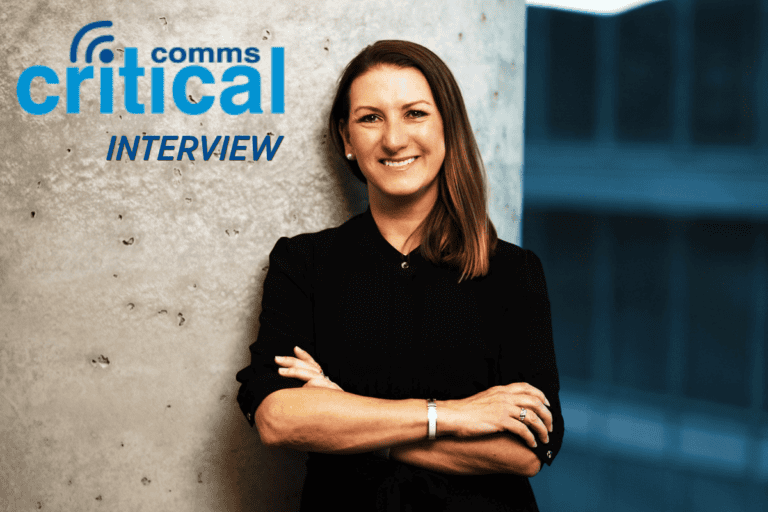




BAI Communications Chief Commercial Officer Elyssa Rollinson speaks to APAC Outlook about role of communications in modern rail, mission-critical connectivity, the Titan ICT acquisition, and why vendor-neutrality matters more than ever.
Who is BAI Communications, and where do you operate?
BAI Communications has been part of Australia’s critical infrastructure for over a century. We design, build, operate, and own networks for broadcasters, government, emergency services, transport operators, and mining and resources enterprises – we provide a communications backbone for anything mission-critical. Most Australians interact with our infrastructure daily without knowing it. We deliver television and radio services to 99% of the population across more than 745 transmission sites, and we operate the NSW Telco Authority’s Public Safety Network, one of the world’s largest public safety radio networks. We also design and deliver private wireless networks and ICT engineering services for some of the country’s most operationally demanding environments.
What does BAI Communications bring to connectivity in mining and the resources sector?
Titan ICT – which will be brought under the BAI Communications brand from 1 May – brings specialist experience in communications for mining and resources operations, including heavy-haul rail networks that are central to the Pilbara mining supply chain. These are demanding environments for wireless communications: long distances, unforgiving conditions, and the safety requirements are stringent. The acquisition of Titan ICT strengthens our private 5G capability. We can now offer clients an end-to-end service, from spectrum licensing and network design through to deployment and ongoing managed support, backed by people with deep operational experience in these environments. Our financial strength means that we can also deploy capital and own infrastructure to deliver shared or dedicated networks for our customers.
What does BAI Communications offer rail operators that sets it apart?
In rail, communications failure is not an operational inconvenience, it is a safety event. Train control, workforce safety, passenger systems, and CCTV all depend on networks that simply cannot go down. We bring delivery experience in that context, not just technical capability on paper. Our engineers have worked across rollingstock wireless, wayside networks, mission-critical push-to-talk, and IT/OT convergence in real rail environments. We are also vendor-neutral. When we make a recommendation, it is based on what is operationally right for the client, not what we have a commercial incentive to sell.
How does your international rail MCX experience translate to Australia?
Several members of our rail team built their careers delivering large-scale mission-critical communications projects internationally for BAI Communications (the Northern Hemisphere organisation is now Boldyn Networks). The experience our people have gained in establishing communications in the New York, Toronto, and London subway systems is invaluable. Our ongoing relationship with Boldyn Networks means we stay close to how 5G MCX is being implemented in networks like Deutsche Bahn, amongst the most advanced rail 5G programmes in the world. This is a genuinely useful live reference point when designing something like Sydney Metro West.
Tell us about your partnership with MTR Corporation.
We have a long-standing relationship with MTR Corporation, one of the world’s most respected metro rail operators. We’re delighted to continue working with them outside their Hong Kong operations, partnering on the Sydney Metro West project, which connects Sydney CBD to Parramatta through 24km of tunnel and eight new underground stations. BAI Communications’ role in the project involves designing, building, and operating the communications network for Australia’s first metro rail network built on a 5G MCX platform. It draws on everything BAI does: private and public wireless network design, public safety connectivity, and systems integration, all coming together to enable safety-critical communications. It is also a project that benefits directly from the international MCX experience our team carries. For Australian rail, it sets a new benchmark. For BAI Communications, it is the clearest demonstration of what we are capable of delivering.
To explore BAI’s capabilities in mission-critical communications, visit bai360.baicommunications.com