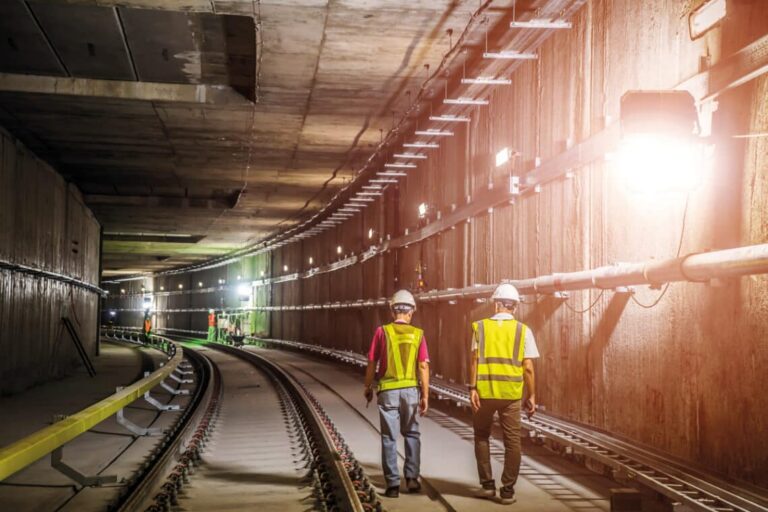



Earlier this year, BAI Communications landed a major contract to deliver critical radio communications systems for Sydney Metro West. This was an important win for the telecommunications company, attracting significant media coverage – but there is a much bigger story behind the headlines.
Rail Express found out more from Mathew Wegener, BAI’s new National Growth Manager for Rail.
A trusted partner
BAI Communications has been part of Australia’s critical infrastructure for more than a century.
It designs, builds, owns and operates the networks that power the nation’s most important operations – and it’s expanding fast, from mining and ports to passenger and heavy haul rail.
The company operates one of the most extensive broadcast networks globally, delivering television and radio services to 99 per cent of Australians.
It also operates the New South Wales Telco Authority’s Public Safety Network, one of the world’s largest public safety radio networks, at 99.995 per cent availability – connecting police, fire, ambulance and other emergency services.
“The network has stayed live through extreme tests – from floods and fires to cyclones – without frontline agencies losing service,” said Wegener.
Before BAI separated into two businesses in 2023, with Boldyn Networks now covering the northern hemisphere, it delivered large-scale communications systems throughout rail corridors in major cities around the world.
It built all of the communication systems for public cellular connectivity in the New York City Subway stations, as well as the communications networks for the London Underground.
“For the New York Subway and London Underground, we delivered communications across mission-critical emergency services and mobile network operator (MNO) coverage solutions,” said Wegener. “We’re talking about 300 or 400 stations and hundreds of kilometres of track and tunnels.
“These are very large-scale, complex, multi-technology solutions that needed to be integrated together in a live railway environment.
“Following the corporate restructure, BAI still draws on that experience and retains that capability.”
Wegener said risk is always a big concern for transport authorities and rail operators, both commercially and operationally, but they can rest assured that their networks are in safe hands with BAI.
“What the task will be in Australia is the same as it was for London and New York, and we have shown we have the ability to deliver it,” he said.
“It’s very easy to roll out communications on a greenfield network, but what BAI brings to the table is that expertise in a brownfield environment.
“You’ve got a lot more operational complexities and more legacy equipment in a live environment where you’re trying to install new equipment. BAI has raised the bar in finding solutions to those challenges.”
Many of the skilled team who have worked on BAI’s international rail projects like the London and New York systems are from Australia, and are now applying their experience to Australian projects.
Their skills will prove invaluable on Sydney Metro West and other local rail projects, Wegener noted.
“We understand the efficiency and planning required on projects like these, but we also know that no matter how well you plan, there will always be challenges. It’s about being able to lean on the technical skill set of our team, so we can pivot when we need to and get the job done.”
From legacy to cutting edge
From a systems integrator perspective, Wegener said BAI has the experience and skills to work with and maintain legacy infrastructure until the next generation of technology is deployed.
He explained that the communications spectrum for rail is still being finalised by the Australian Communications and Media Authority (ACMA) and as such, spectrum uncertainty is causing project delays.
There has also been a delay finalising the FRMCS standards. This evolving global standard is designed to replace ageing systems over the next decade and revolutionise rail systems.
“We’ve had these rail operators relying on legacy infrastructure, and they know it’s legacy, but they’ve been forced into a situation beyond their control to extend the life of the existing infrastructure,” Wegener said. “They’ve had to maintain older infrastructure longer than they thought they would, and we have been able to help them with that.”
At the same time, BAI has the expertise to support rail networks as they embrace new technologies such as the European Train Control System, or ETCS.
For Sydney Metro West, it will deliver a private 5G (fifth generation) network that will enable operational radio systems, train communications, and rail signalling, as well as ensuring seamless 4G/5G coverage for passengers.
“It’s Australia’s first 5G Mission-Critical Services (MCX)-based radio communication system, with a clear pathway to FRMCS,” Wegener added.
Connecting heavy haul
BAI is working with mines and ports on private 5G across Australia.
The company has recently grown its capabilities in the mining space with its acquisition of Titan ICT, an advanced engineering firm.
BAI can now offer an end-to-end service from spectrum licensing and network design through to deployment and ongoing managed support.
“A mine site can rely on BAI because we understand the end-to-end infrastructure and all the pieces of the puzzle,” said Wegener. “This allows fault resolution times to be reduced, uptime to be maintained, and costs for maintenance to be reduced because you’ve got synergies and you’ve got scale.”
Wegener said BAI’s depth of knowledge is necessary in remote heavy haul environments.
“You can’t just bring experts to the table very quickly or run down the street and buy a new piece of hardware,” he explained. “Again, that’s where our planning expertise and understanding come in handy.”
The pillars of a network
Wegener said BAI has the ability to build, maintain and operate the three key pillars of any communications network – that is the mission-critical communications that run the signalling and the MCX voice; the emergency services; and the mobile network operators.
“BAI can deliver all of these pillars under one contract, and the business is also recognised as a DAS Infrastructure Operator by the MNOs,” he added.
“What is different here is that BAI can go and build DAS infrastructure for these communications environments, whether it be a tunnel or a train station, and make it available to the mobile network operators.
“Our existing connection agreement with Telstra provides a streamlined lead carrier approval process and facilitates multi-operator connectivity.
“It’s not very common to find an integrator with spectrum to support rail use cases and be recognised by the MNOs as a DAS Infrastructure Operator.”
The updated Australian design guideline for Distributed Antenna Systems/DAS, MCF2025, has recently changed things for the rail industry. A DAS is a network of separated antenna nodes connected to a common source that boosts mobile and wireless network signals inside places like train stations and tunnels, where signals normally drop.
Wegener said BAI will make any necessary transitions easy for its customers.
“We do this every day of the week,” he said.
“We also understand how the supplier ecosystem will evolve with the new standards coming in.
“There’s not as much plug and play with suppliers as one would like. We know the best of breed within these vendor ecosystems, and we know how to put them all together.”
BAI holds licensed spectrum in Australia to deploy and run private mobile networks, as well as the capacity to own or co-own infrastructure.
“If an organisation has challenges around capital expenditure, we can come to the table with a turnkey, end-to-end solution, and we can co-fund or primarily fund that,” Wegener said.
“This drives confidence that the networks that are being deployed will have that resilience, uptime and availability for users to enjoy.”
Local support around the clock
BAI’s networks are underpinned by a 24/7 Network Operations Centre (NOC) based in Australia.
“A lot of global Original Equipment Manufacturers (OEMs) will centralise overseas in terms of their operations, but when you look at the requirements of the Security of Critical Infrastructure Act (SOCI) from the Federal Government, there are a lot of restraints around offshoring those types of activities,” said Wegener.
“BAI has a 24/7 NOC in Sydney, monitoring millions of messages and alarms every year, making sure that downtime is minimised because there is that local presence that understands the environment, as opposed to it being a large international operations centre.
“With this operational approach, reactiveness and certainty of action can be streamlined.”
Wegener emphasised that the role of communications in rail will continue to grow, making its reliability even more critical.
“With everything from autonomous trains to predictive maintenance programs driven by artificial intelligence, the benefits come from having the communication solution available to rolling stock and to the overall operational environment.
“Getting it right from the start is crucial, and that’s where BAI comes in.”