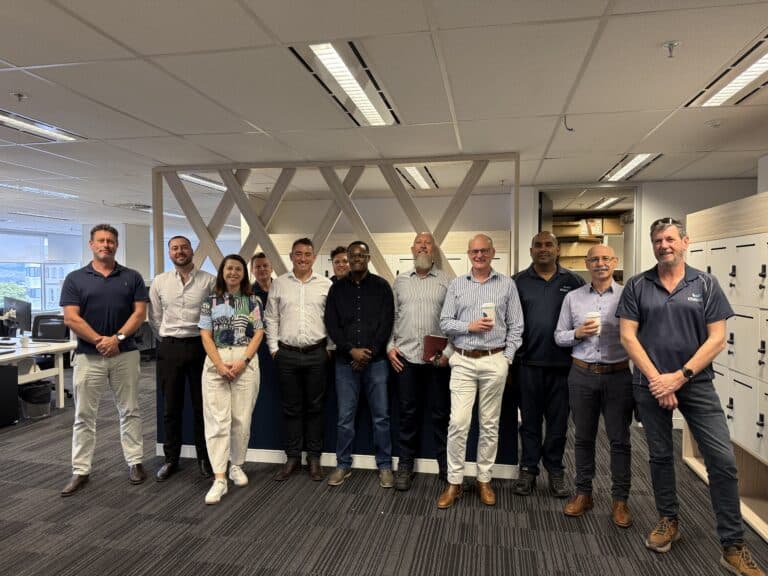



Mission-critical communications and specialist rail infrastructure delivery, combined in one integrated solution
BAI Communications (BAI) and Martinus Group have signed a teaming agreement to modernise communications across Australia’s existing passenger and freight rail networks. The strategic alliance combines BAI’s international leadership in mission-critical rail communications and telecommunications with Martinus’ proven capability to deliver complex rail infrastructure in live operating environments.
Formalised on 24 November at Oceania’s premier rail sector conference and exhibition, AusRail, the non-exclusive partnership will initially focus on Digital Train Radio System (DTRS) and fifth-generation mobile technology (5G). BAI will lead technology and systems integration, while Martinus will build and maintain the infrastructure on operational railways.
The partnership will pursue significant, long-term rail communications modernisation programs in Australia, with the potential to serve international markets. Under the agreement, the partners will provide:
- Design and systems integration: BAI will lead the design of DTRS, private 5G and wireless networks, and integrate mission-critical communications with signalling, train control and existing operational systems.
- Specialist rail delivery and commissioning: Martinus will manage rail project delivery and corridor access, carry out brownfield installation of DTRS and 5G infrastructure on live railways, and support testing and commissioning through to safe handover into operations.
- Lifecycle support: BAI will provide network operations and lifecycle support, with Martinus delivering ongoing infrastructure maintenance.
Rail operators across Australia are modernising their communications to support advanced signalling and train control, including the European Train Control System (ETCS) and to prepare for the Future Railway Mobile Communication System (FRMCS), the global standard set to replace legacy Global System for Mobile Communications – Railway (GSM-R) networks. Modern communications networks form the digital backbone for the next generation of rail, enabling higher-capacity signalling and, ultimately, automated train operations. On existing networks, these upgrades must interoperate with legacy equipment and be installed within limited corridor access windows while passenger and freight services continue to run. Working as one coordinated team, BAI and Martinus will give operators a single partner across the full project lifecycle, reducing delivery risk and disruption.
Mathew Wegener, National Growth Manager Rail, BAI Communications: “Australia’s rail operators are investing in communications that will underpin safer, more reliable and higher-capacity services for decades to come. BAI brings proven capability in designing and integrating mission-critical networks, and was this year selected to provide the radio communications system for Sydney Metro West, Australia’s first contract for a 5G MCX-based radio communication system and a clear pathway to FRMCS.
“Martinus is one of Australia’s most respected specialist rail contractors, with deep experience building and maintaining infrastructure in live rail networks. Together, we can bring this technology to existing passenger and freight networks safely and efficiently.”
Treaven Martinus, CEO, Martinus Group: “Railways are becoming technology platforms. The networks of the next 20 years will be defined as much by digital systems as by steel, and building our capability in rail communications and technology is a deliberate part of Martinus’ future. Complex work on operational railways should be led by specialist rail contractors. Our teams understand what it takes to build, commission and maintain systems safely in live rail corridors, with limited access and services running concurrently. BAI Communications has a strong international track record in deploying complex communications solutions. By pairing this with our specialist rail capability, we can offer operators technology-led solutions built by people who really understand rail.”
Prior to the restructure of BAI through the establishment of its sister organisation Boldyn Networks, which today serves the Northern Hemisphere, the business delivered communications infrastructure for major rail systems in London, New York City and Hong Kong.